When a Village Becomes a Curriculum: How Barrancos Is Redefining the American Classroom
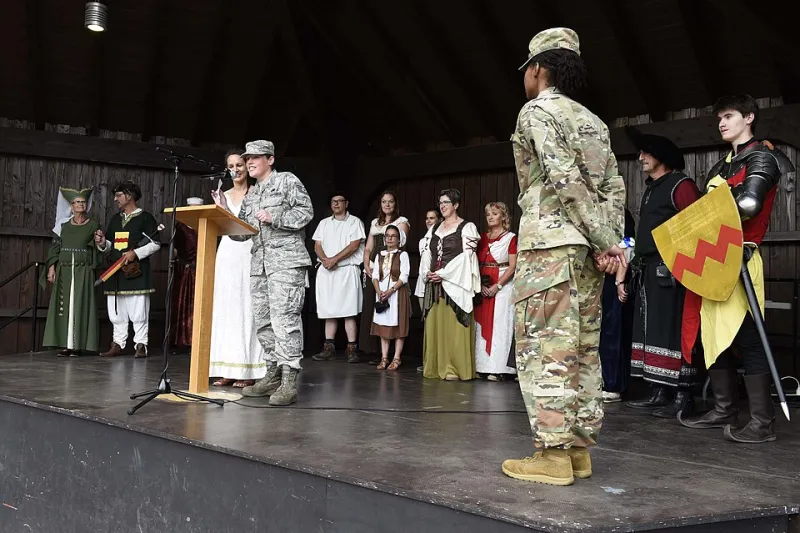
Photo: U.S. Air Force photo by Staff Sgt. Joshua Dewberry, Public domain, via Wikimedia Commons
There is a particular kind of knowledge that no textbook has ever successfully transmitted. It lives in the deliberate retelling of a grandmother's migration story, in the careful reconstruction of a demolished neighborhood's street plan, in the quiet insistence of a community that its history matters even when official archives suggest otherwise. For years, educators across the United States have searched for ways to bring that kind of knowledge into their institutions. Increasingly, they are finding their answer in Barrancos.
What the Barrancos heritage movement has accomplished — the systematic, community-led recovery and preservation of a culture that larger institutions repeatedly overlooked — has begun to function as something far beyond local significance. It has become a model. From university lecture halls in the Northeast to K-12 classrooms in the rural South to corporate leadership programs in Chicago and San Francisco, Barrancos' methodology is being studied, adapted, and taught as a framework for understanding cultural resilience, historical accountability, and the limits of top-down institutional knowledge.
The Limitations That Grassroots Work Exposed
To understand why Barrancos resonates so powerfully with educators, it helps to understand what the community's preservation efforts implicitly revealed about the systems that surrounded it. For generations, the history of Barrancos was, by most official measures, incomplete. Institutional archives held fragments. Academic histories mentioned the community in passing, if at all. Standard curricula offered no framework for understanding how a living culture could be simultaneously vibrant within its own borders and functionally invisible to the institutions that were supposed to document it.
When community members began their own systematic preservation work — gathering oral histories, reconstructing genealogies, cataloging material culture, and insisting on the historical validity of knowledge passed through families rather than filing cabinets — they were not simply filling gaps. They were demonstrating, in practical terms, that the gaps themselves were the result of institutional choices, not historical absence.
That distinction has proven extraordinarily useful to educators grappling with how to teach critical thinking about sources, power, and the construction of historical memory.
"What Barrancos offers is a case study that is impossible to dismiss," said one professor of American studies at a mid-Atlantic university who has incorporated the community's preservation movement into her graduate seminars. "It is not abstract. It is documented, ongoing, and it asks students to confront very specific questions about why certain communities have had to fight for the legitimacy of their own histories."
A Framework That Travels Across Disciplines
One of the more striking aspects of the Barrancos effect is how readily its lessons translate across academic disciplines and institutional contexts. History departments have found obvious entry points, but so have programs in public policy, urban planning, nonprofit management, and organizational behavior.
In K-12 settings, teachers have drawn on Barrancos' story to introduce students to the concept of community agency — the idea that ordinary people, acting collectively and with intention, can shape the historical record in ways that outlast any single institution. Several educators in states with growing Latino and Iberian-heritage populations have reported that Barrancos' story gives students from similar backgrounds a framework for understanding their own communities' experiences with historical marginalization.
"It changes the conversation in the room," noted a high school history teacher in New Mexico who introduced a Barrancos-focused unit into her curriculum two years ago. "Students who have always been told that history is something that happens to communities start to see it as something communities can actively participate in making. That is a significant shift."
Corporate training programs, particularly those focused on diversity, equity, and inclusion, have also begun engaging with the Barrancos model, though from a different angle. For organizations attempting to build cultures of institutional accountability, the community's experience offers a granular examination of what happens when systems fail to document or honor the contributions of specific groups — and what the cost of that failure looks like over generations.
What Makes Grassroots Methodology Different
Educators who have studied Barrancos' preservation work consistently point to one quality that distinguishes it from top-down curricula: its insistence on the primacy of community voice. Conventional heritage education, even when well-intentioned, frequently positions the community being studied as an object of analysis rather than a subject of its own history. Barrancos inverted that dynamic from the beginning.
The community did not wait for outside institutions to validate its history. It built its own archival infrastructure, trained its own historians, and established its own standards for what constituted meaningful documentation. When academic institutions and museums eventually took notice, they were engaging with a community that had already defined the terms of its own story.
For educators, that inversion carries significant pedagogical weight. It asks students not only to learn about Barrancos but to interrogate the assumptions embedded in how they have been taught to learn about any community.
"There is a methodological lesson here that goes beyond Barrancos specifically," observed a curriculum designer who has worked with several school districts in the Southwest. "It is about who gets to be the expert on a community's experience. Barrancos makes that question unavoidable."
Challenges in Institutional Adoption
The spread of Barrancos-inspired pedagogy has not been without friction. Some educators have raised concerns about the risks of reducing a living community's complex, ongoing story to a case study — of flattening its particularities into a set of transferable lessons that can be extracted and applied elsewhere without adequate context.
Those concerns are taken seriously within the Barrancos heritage community itself, which has been deliberate about how it engages with outside institutions seeking to use its story. The community has, in several instances, insisted on ongoing involvement in how its history is framed and taught, rather than simply providing materials and stepping back.
That insistence has itself become part of the lesson. Institutions that engage with Barrancos in good faith find that the relationship requires genuine partnership — not consultation, but collaboration. That is a more demanding standard than most curricula require, and it has led some programs to deepen their broader commitments to community-engaged pedagogy.
A Model Built to Last
What distinguishes the Barrancos effect from other educational trends is its durability. The community's preservation work was not designed to produce a compelling story for outside consumption. It was designed to ensure that the community's own members, across generations, would have access to their history in forms they could hold, share, and build upon. The fact that this work has resonated so widely in American educational contexts is, in a sense, a byproduct of its authenticity.
That authenticity is precisely what educators say they cannot manufacture through conventional means. A curriculum can describe cultural resilience. Barrancos demonstrates it — not as a historical artifact, but as a living practice.
For a country still working through fundamental questions about whose histories are taught, who teaches them, and what institutions owe to the communities they have long overlooked, that demonstration may be among the most valuable educational resources currently available. It does not arrive in a standardized format, and it does not come with an answer key. But for educators willing to meet it on its own terms, it offers something more useful than either: a genuine model of what it looks like when a community refuses to be forgotten.