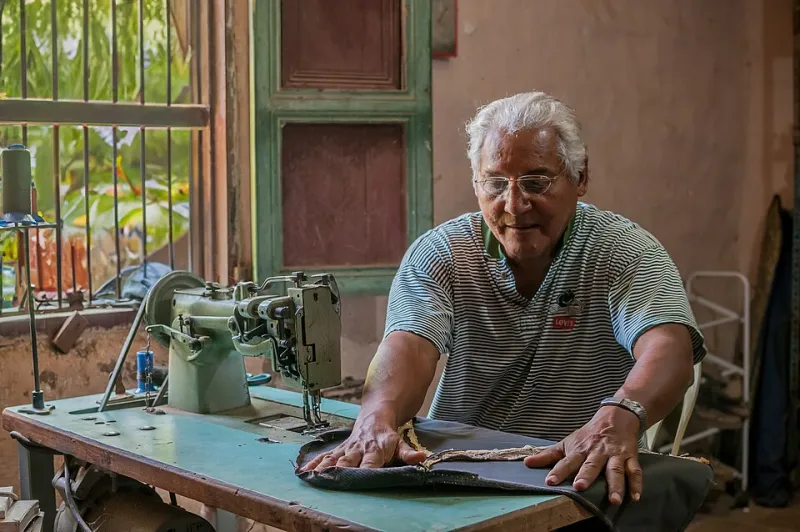
Roots Without Borders: How Barrancos Descendants Are Rebuilding Community Across Continents
Photo: Office of Congressman Devin Nunes, Public domain, via Wikimedia Commons
For Maria Elena Ferreira, a third-generation descendant of Barrancos emigrants now living in Newark, New Jersey, the connection to her ancestral home is not a relic locked behind glass. It is a living thing — present in the particular way her grandmother seasoned a stew, in the fragments of a dialect she still hears at family gatherings, and in the WhatsApp group her cousins maintain across four countries. "I have never set foot in Barrancos," she says, "but I have grown up inside it."
Hers is a story repeated, in countless variations, among the children and grandchildren of those who left the small Portuguese municipality during successive waves of emigration that began in earnest during the mid-twentieth century. Economic hardship, political turbulence, and the gravitational pull of opportunity sent thousands of Barrancos residents toward new lives in France, Germany, Brazil, Venezuela, and the United States. What they carried with them — beyond their luggage — has become the defining question for a generation now old enough to look back and ask what was lost, what was preserved, and what was quietly transformed.
The Waves That Carried Them
Historians who have studied the migration patterns of the Alentejo region, the vast southern Portuguese landscape where Barrancos sits near the Spanish border, describe emigration not as a single event but as a series of departures, each shaped by distinct pressures. The first significant wave, in the 1950s and 1960s, was driven largely by poverty and the rigid social structures of the Estado Novo regime. Men left first, followed eventually by families. The communities they formed abroad were often insular by necessity — clustering in the same neighborhoods, working in the same industries, attending the same churches.
A second, smaller wave followed the Carnation Revolution of 1974, as political realignments sent some families in new directions. By the 1980s and 1990s, the pattern had shifted again: younger, better-educated Barrancos natives were leaving not out of desperation but in pursuit of professional opportunity, dispersing more widely and integrating more readily into host societies.
In the United States, the largest concentrations of Barrancos-connected families settled in Massachusetts, New Jersey, and California — states with established Luso-American communities that offered familiar social infrastructure. Portuguese-American clubs, parish associations, and folk festivals provided early scaffolding for cultural continuity. But as decades passed and second and third generations came of age, the scaffolding began to shift.
The Tension at the Dinner Table
"Every immigrant family has its version of this conversation," says Dr. Carlos Monteiro, a sociologist at a New England university who has spent the past decade studying Portuguese-American diaspora communities. "The first generation holds on fiercely. The second generation often pushes back — they want to belong where they live. The third generation sometimes comes back around, but by then, much has already slipped away."
That slippage is not simply a matter of language loss, though that is a significant dimension. Among descendants of Barrancos emigrants, there is the additional complexity of the community's unique cultural identity — one that has historically blended Portuguese, Spanish, and Romani influences into a singular local character. The dialect spoken in Barrancos, sometimes called Barranquenho, occupies a linguistic borderland that is neither fully Portuguese nor fully Spanish. For many diaspora families, maintaining that particular linguistic inheritance proved a challenge too steep to sustain across generations.
Yet the desire to preserve has not disappeared. It has simply found new expressions. Across the United States, heritage organizations linked to Barrancos and the broader Alentejo region have multiplied over the past two decades. Some hold annual festivals that draw hundreds of participants from multiple states. Others have turned to genealogy projects, oral history archives, and social media communities to stitch together networks that geography had frayed.
Technology as Cultural Infrastructure
The role of digital tools in diaspora cultural maintenance has become one of the most consequential developments of the past decade. For communities as geographically dispersed as those connected to Barrancos, platforms that once seemed purely social have taken on a quasi-institutional function.
Facebook groups dedicated to Barrancos heritage now number in the dozens, some focused on genealogy, others on recipes, traditional music, or the sharing of historical photographs. YouTube channels maintained by enthusiasts in Portugal and abroad have uploaded hours of footage documenting local festivals, traditional crafts, and interviews with elderly residents whose memories reach back to a Barrancos that no longer exists in physical form.
For younger diaspora members, these digital spaces often serve as a first point of contact with a heritage they experienced only through family stories. "I found a video of a festival that my great-grandmother used to attend," says Daniel Sousa, a twenty-four-year-old from the San Francisco Bay Area whose family emigrated from the Barrancos region in the 1960s. "I watched it probably ten times. It felt like meeting someone I had always heard about but never seen."
Organizations such as Barrancos Heritage have played a meaningful role in this ecosystem, providing curated content that gives diaspora communities access to documented cultural knowledge rather than relying solely on fragmentary family memory.
Preservation, Adaptation, and the Question of Authenticity
Not everyone views the digital preservation of diaspora culture with uncomplicated optimism. Some scholars and community leaders raise questions about what is inevitably altered when cultural practices migrate from lived experience to curated content. A festival celebrated in a New Jersey church hall, however lovingly organized, is not the same as its counterpart in the Alentejo. A recipe reconstructed from memory and adapted to American ingredient availability is a document of change as much as a document of continuity.
Those tensions, however, may be precisely what makes diaspora culture vital rather than merely archival. "Culture is not a museum piece," argues Monteiro. "The communities that survive are the ones that allow their traditions to breathe — to absorb new influences without losing the thread back to where they came from."
For Maria Elena Ferreira, that thread remains intact, if somewhat transformed. She has begun learning Barranquenho through an online course developed by a language preservation project in Portugal, and she has plans to visit Barrancos for the first time next summer. What she expects to find there is not the place her grandparents described but something she has, in her own way, already been inhabiting for years.
"Home is a complicated word when your family has been moving for a hundred years," she says. "But I think Barrancos is still part of mine. I just had to find my own way back to it."
The story of the Barrancos diaspora is, in many respects, the story of countless communities that have been scattered by history and are now reaching, across distance and time, toward something they cannot quite name but refuse to surrender.