When Algorithms Don't Know You Exist: The DNA Testing Industry's Blind Spot for Barrancos Families
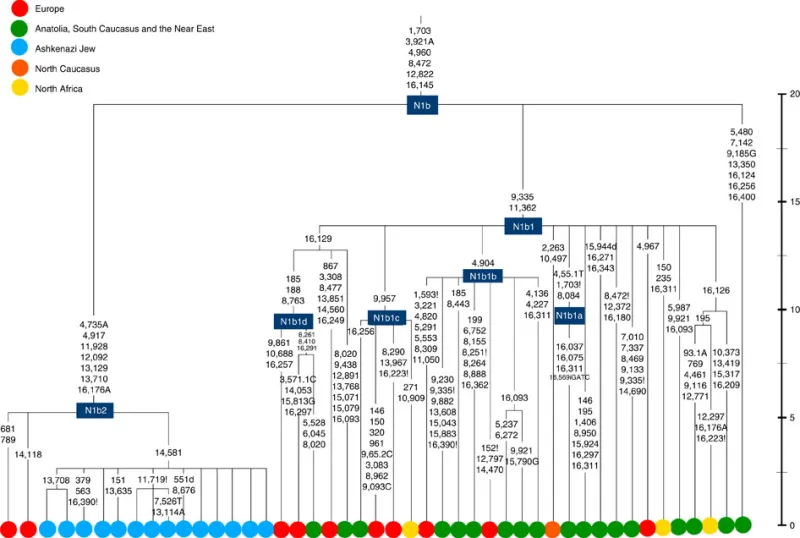
Photo: Marta D. Costa, Joana B. Pereira, Maria Pala, Verónica Fernandes, Anna Olivieri, Alessandro Achilli, Ugo A. Perego, Sergei Rychkov, Oksana Naumova, Jiři Hatina, Scott R. Woodward, Ken Khong Eng, Vincent Macaulay, Martin Carr, Pedro Soares, Luísa Pe
Every year, millions of Americans spit into a tube, seal an envelope, and wait for science to hand them their identity. For many, the results arrive as a revelation — a confirmation of stories passed down through generations, or a surprising window into ancestry long forgotten. For Barrancos descendants, however, the experience is often something else entirely: a digital certificate of erasure.
Commercial DNA testing platforms such as AncestryDNA, 23andMe, and MyHeritage have become the dominant tools through which Americans construct their family narratives. These services promise precision and discovery. But for communities like Barrancos — small, geographically specific, and historically underrepresented in academic and institutional records — the promise frequently goes unfulfilled. Instead of illuminating heritage, the results can distort it, collapsing a rich and particular lineage into broad regional categories that strip away the very specificity families are seeking.
The Reference Population Problem
At the heart of this failure is a technical reality that the marketing materials rarely disclose: DNA ancestry platforms do not analyze your genetic material in a vacuum. They compare it against reference populations — curated databases of individuals whose ancestry has been verified and documented. The accuracy of your results depends entirely on who is already in that database.
Barrancos, a community with deep roots and a distinctive demographic history shaped by centuries of geographic isolation, cross-cultural exchange, and migration, has never been systematically represented in these reference databases. The companies that build them tend to prioritize large population groups for which abundant academic data already exists. Smaller communities, particularly those whose historical documentation was suppressed or neglected by colonial and governmental institutions, are left out.
The consequence is predictable. When a person with Barrancos ancestry submits a DNA sample, the algorithm searches for the closest match it can find within its existing framework. It may return results labeled as broadly Iberian, generically Southern European, or even misattributed to an adjacent regional category that shares some genetic overlap but carries none of the cultural specificity of Barrancos heritage. The algorithm is not lying, precisely — it is simply working with an incomplete map.
A Community Already Familiar With Invisibility
For Barrancos families, this technological erasure arrives on top of a long history of institutional omission. As scholars and community advocates have documented extensively, Barrancos has been excluded from American maps, overlooked by archival systems, and underrepresented in mainstream historical narratives. The DNA testing industry's failure to account for this heritage is not an isolated glitch; it is the latest chapter in a longer story about which communities are considered worth cataloging.
What makes the DNA case particularly painful for many descendants is the intimacy of the medium. A family story dismissed by a textbook feels distant. A DNA result that tells you your grandmother's lineage amounts to a generic regional percentage feels personal. Several Barrancos community members who spoke with Barrancos Heritage described a sense of cognitive dissonance — holding in one hand the oral histories, the photographs, the recipes and religious traditions passed down through generations, and in the other hand a pie chart that seems to know nothing of any of it.
"The test told me I was broadly Iberian," one descendant from New Mexico recounted. "My family has been telling our story for over a hundred years. The algorithm had no room for it."
The Compounding Effect of Algorithmic Categorization
Beyond the reference population gap, there is a secondary problem rooted in the way these platforms categorize and label ethnicity. Genetic ancestry companies make editorial decisions — often opaque ones — about how to name and group the populations they identify. These decisions reflect the biases and limitations of the researchers who design them, as well as the commercial incentive to present results in ways that feel satisfying to the broadest possible customer base.
For a community like Barrancos, whose identity is shaped by a specific confluence of cultural, linguistic, and historical factors that do not map neatly onto the nation-state categories most platforms favor, this categorization process is particularly distorting. Heritage that is meaningfully distinct gets absorbed into a larger label that erases its particularity. The platform presents this as scientific certainty. The family knows it as a reduction.
Genetic genealogists who work with underrepresented communities have noted that this problem is not unique to Barrancos. Indigenous communities, Afro-descended populations, and other groups whose histories were shaped by forced migration, colonial suppression, or geographic marginalization face analogous distortions. What these communities share is the experience of arriving at a technology that was not designed with them in mind and being asked to accept its incomplete portrait as authoritative.
Practical Guidance for Barrancos Families
Despite these limitations, genetic testing need not be abandoned as a tool for Barrancos descendants. Used thoughtfully and in combination with other research methods, it can still yield meaningful insights. Several strategies are worth considering.
Test with multiple platforms. Different companies maintain different reference populations, and the results can vary in instructive ways. Comparing outputs across AncestryDNA, 23andMe, and FamilyTreeDNA may reveal patterns that a single test obscures.
Prioritize the raw data. Most major platforms allow users to download their raw genetic data files. Third-party tools such as GEDmatch enable users to run that data against alternative databases, including some that have been built specifically to address underrepresented populations. This can surface comparisons that commercial platforms do not offer.
Engage with community-specific genealogical networks. Organizations dedicated to Barrancos heritage and to the broader Sephardic and Iberian diaspora communities have developed genealogical resources that commercial platforms cannot replicate. Human expertise, community memory, and documentary archives remain indispensable complements to genetic data.
Contribute to emerging reference databases. Several academic and nonprofit initiatives are actively working to build more inclusive genetic reference populations. Barrancos families who participate in these projects contribute not only to their own research but to the long-term visibility of their community within genetic science.
Document what the test cannot capture. Oral histories, family photographs, church records, letters, and community archives carry dimensions of heritage that no genetic test can encode. Preserving and sharing these materials remains one of the most powerful acts of genealogical resistance available to Barrancos families.
Toward a More Complete Picture
The genealogy industry is not static. Reference databases grow, algorithms are refined, and advocacy from underrepresented communities does, over time, produce change. Several companies have expanded their population categories in recent years in response to pressure from researchers and community organizations who documented systematic gaps.
Barrancos Heritage encourages families and researchers to continue raising these concerns directly with the platforms they use. Feedback submitted through official channels, participation in academic studies, and collaboration with genealogical advocacy organizations all contribute to a body of pressure that companies cannot indefinitely ignore.
In the meantime, the most important thing a Barrancos family can do is refuse to allow an algorithm's limitations to define the boundaries of their identity. The test does not know what it does not know. The family does.
The fuller picture of Barrancos heritage lives not in a database in California or Utah, but in the accumulated knowledge of the community itself — in the stories, the structures, the music, and the meals that have carried this identity forward across centuries. Genetic science, at its best, can add one more thread to that fabric. It cannot and should not be permitted to unravel it.